Nitric oxide: A gold molecule
This article describe briefly the nitric oxide, an Nobel Prize 1998 awarded molecule due its role in human physiology.
5/8/20243 min read
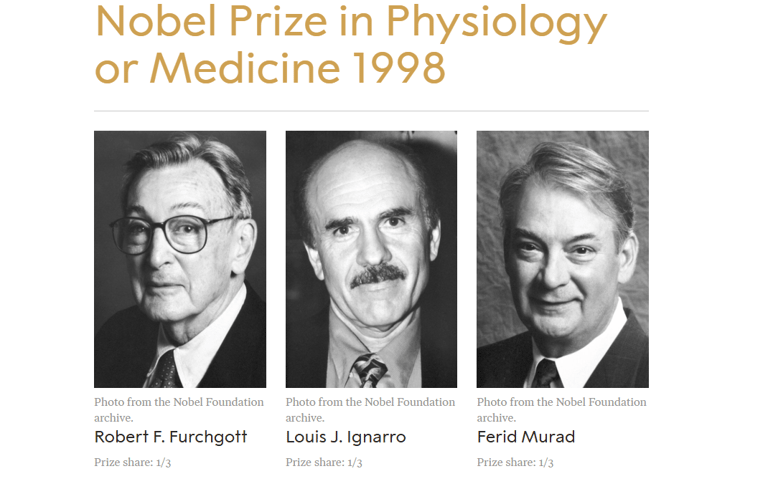
In the vast world of molecules, some shine not because they are made of gold — but because they change how we think about life itself. One of those is nitric oxide (NO): a simple gas, made of just one nitrogen atom and one oxygen atom, but powerful enough to win the 1998 Nobel Prize in Physiology or Medicine.
But why would such a tiny, colourless gas deserve a Nobel?
Let’s find out.
🧬 A Molecule Hiding in Plain Sight
For years, nitric oxide was seen mainly as an environmental pollutant — produced by car engines, lightning, and industry. Few imagined it had any role in the human body. But in the 1980s, scientists started uncovering something astonishing: our bodies make nitric oxide naturally, and it acts as a messenger molecule, helping cells talk to each other.
❤️ The Breakthrough: Blood Vessels and NO
The key discovery came when researchers found that nitric oxide was responsible for relaxing blood vessels, helping control blood pressure and improve blood flow. This was a missing piece in cardiovascular science.
In 1998, the Nobel Prize in Physiology or Medicine was awarded jointly to:
Robert F. Furchgott
Louis J. Ignarro
Ferid Murad
They were recognised for their discoveries concerning “nitric oxide as a signalling molecule in the cardiovascular system.”
Suddenly, NO was no longer just a gas — it was a master regulator of vascular health.
💊 From Molecule to Medicine
The discovery of nitric oxide paved the way for medications that mimic or enhance its effects. For example:
Nitroglycerin, used for over a century to treat chest pain (angina), works by releasing NO.
Viagra (sildenafil), originally developed for heart conditions, works by boosting nitric oxide signalling to improve blood flow — though not in the heart.
🧠💪 Beyond the Heart
Since then, scientists have discovered that NO isn’t just about blood vessels:
🧠 In the brain, it helps neurons communicate.
💪 In muscles, it helps with oxygen delivery and performance.
🛡️ In the immune system, it helps fight infections.
It's even involved in erection physiology, wound healing, and possibly slowing down ageing.
🥦 Nitrates, Diet, and the Future
One of the most exciting parts of the nitric oxide story is that you can boost it naturally — through diet. Foods rich in nitrate, like beetroot, spinach, and rocket, can increase nitric oxide levels in the body and have been shown to lower blood pressure and improve exercise performance.
This has opened new doors in nutrition, sports science, and public health — showing how simple food choices can affect complex body systems.
🌟 Why It's Called a “Gold Molecule”
Nitric oxide has earned nicknames like “the molecule of the century” and “a gold molecule” — not because of its colour or rarity, but because of its immense value to science and medicine. Its discovery changed how we understand human biology, and it continues to inspire new research in heart health, brain function, and beyond.
[The scientific road to the prize.]
1. Ferid Murad (1977):
Murad discovered that nitric oxide increases levels of cyclic GMP, a molecule involved in relaxing smooth muscle (e.g., in blood vessels). Murad, F., Gryglewski, R. J., Mitchell, J. A., & Moncada, S. (1977). Nitric oxide: A molecule with dual roles in the control of vascular tone. Molecular Pharmacology, 13(4), 739–748.
2. Robert F. Furchgott (1980):
Furchgott showed that blood vessel relaxation depended on a substance he called EDRF (endothelium-derived relaxing factor), later identified as nitric oxide. Furchgott, R. F., & Zawadzki, J. V. (1980). The obligatory role of endothelial cells in the relaxation of arterial smooth muscle by acetylcholine. Nature, 288(5789), 373–376. https://doi.org/10.1038/288373a0
3. Louis J. Ignarro (1987):
Ignarro confirmed that EDRF is nitric oxide, using chemical and biological assays. Ignarro, L. J., Buga, G. M., Wood, K. S., Byrns, R. E., & Chaudhuri, G. (1987). Endothelium-derived relaxing factor produced and released from artery and vein is nitric oxide. Proceedings of the National Academy of Sciences, 84(24), 9265–9269. https://doi.org/10.1073/pnas.84.24.9265